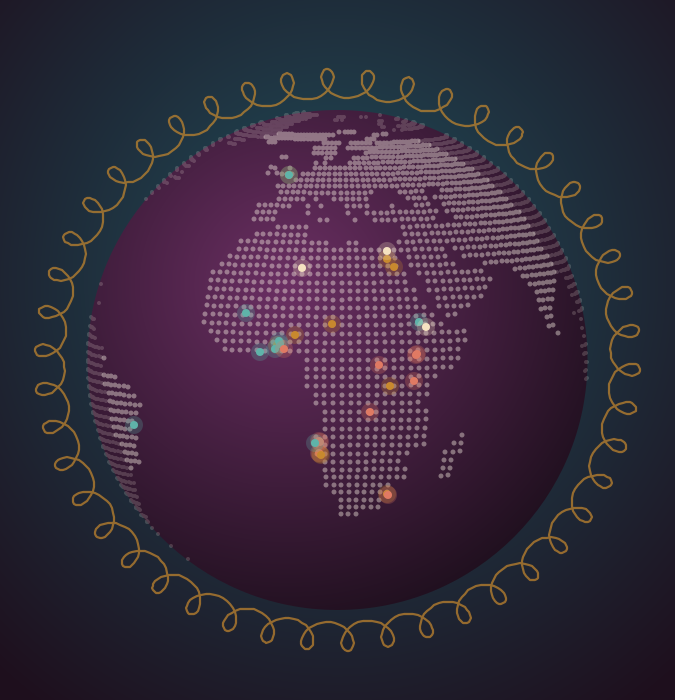
Tap a dot or filter by region, era or who it suits. Each card lists its sources and anything still unverified.
Swipe the map to explore. Tap a dot to jump to its style.
01Gentle when loose
The “Nubian wig”
Egyptian court, after Nubian hair · Egypt & Nubia (Kush)
Ancient · New Kingdom, 18th Dynasty
Elite court fashion linked to queens Kiya, Nefertiti and Tiye.
For kids: As inspiration for a short, rounded coily cut. Not a heavy wig on a child.
How it’s done and sources
- Technique
- A wig of tightly curled plaits built up in tiers.
- Signature
- A rounded, layered cap of small curls, often with a diadem.
- Check before repeating
- An Egyptian fashion modeled on Nubian hair; most surviving wigs used non-coily hair. Don’t caption it “Nubian hair.”
Sources The Met · Royal head with Nubian wig · Wikipedia · Nubian wig
02Gentle when loose
Maiherpri’s natural spirals
Nubian fan-bearer · Valley of the Kings, Egypt
Ancient · 18th Dynasty
Rare physical evidence of Type 4 hair styled at the Egyptian court.
For kids: A gentle coil-defining style.
How it’s done and sources
- Technique
- His own coily hair set in short, tight spirals.
- Signature
- A natural, sculpted coil pattern.
- Check before repeating
- Description seen in a reproduction of Joann Fletcher’s work; check the original before quoting.
Sources Fletcher · An ancient Egyptian wig (ResearchGate)
03Art & history
Sidelock of youth
Children of all classes · Ancient Egypt
Ancient · Pharaonic Egypt
The hieroglyphic sign for “child.”
For kids: An ancient illustration only, not a modern recommendation.
How it’s done and sources
- Technique
- A shaved head with one long lock left at the side, sometimes braided.
- Signature
- A single side lock.
- Check before repeating
- Popular source; confirm with a museum object before publishing details.
Sources Ancient Origins · Wigs in ancient Egypt (popular source)
04Art & history
Saharan rock-art braids
Ancient Saharan herders · Tassili n’Ajjer, Algeria
Ancient · c. 6000 BCE onward
Pastoral life and ceremony.
For kids: An art reference.
How it’s done and sources
- Technique
- Painted figures with patterned, row-like or crested hair.
- Signature
- Rows and crests on painted heads.
- Check before repeating
- Popular claims that cornrows date here to 3000 BCE have no primary citation. Say “rock art suggests braided styles thousands of years old.”
Sources UNESCO · Tassili n’Ajjer · Trust for African Rock Art · Algeria
05Gentle when loose
Nok bun coiffure
Nok culture · Central Nigeria
Ancient · c. 500 BCE–500 CE
Probably high rank.
For kids: As a modern version with loose mini-buns or knots.
How it’s done and sources
- Technique
- Sculpted rows of conical buns, crests and tresses.
- Signature
- “Three rows of seven conical buns” on the Kimbell figure.
Sources Kimbell Art Museum · Nok figure · National Commission for Museums and Monuments · Nok head
06Gentle when loose
Irun kiko (threading)
Yoruba · Southwest Nigeria
Traditional · Traditional, still worn
Femininity, pride and length protection.
For kids: Loose “stretching” threading is gentle and heatless. Never wrap tightly at the root.
How it’s done and sources
- Technique
- Sections wrapped with black thread, then bent into shapes.
- Signature
- Stiff, wrapped “antennae,” arches and cages.
Sources Wikipedia · African hair threading · Juliana Kasumu · Irun Kiko
07Older kids, loosely
Shuku (Sùkú)
Yoruba · Southwest Nigeria
Traditional · Historic royal form; worn today
Once for queens and wives of kings; now worn by everyone, including at school.
For kids: Keep the edges loose and the rows chunky.
How it’s done and sources
- Technique
- Cornrows braided upward to meet in a raised crown.
- Signature
- A basket or bun peak on top.
Sources Yoruba Library · Yoruba women’s hairstyles · Oriire · The roots of the Suku
08Older kids, loosely
Koroba
Yoruba · Southwest Nigeria
Traditional · Traditional and modern
A named everyday style.
For kids: Loose and chunky for kids.
How it’s done and sources
- Technique
- Braids radiating from the crown down on all sides.
- Signature
- An “upturned bucket” shape.
Sources Yoruba Library · Yoruba women’s hairstyles
09Older kids, loosely
Ìpàkó Elédè, Ogun Pari & Aro Meta
Yoruba · Southwest Nigeria
Traditional · Traditional named styles
Commemorative and social. Ogun Pari means “the war is over.”
For kids: Loose versions for older kids.
How it’s done and sources
- Technique
- Braided styles with set shapes; Aro Meta has three heaps.
- Signature
- One heap at the front and two at the back (Aro Meta).
Sources Yoruba Library · Yoruba women’s hairstyles
10Older kids, loosely
Fulani braids
Fula (Fulani, Peul) · The Sahel
Traditional · Traditional and modern
Identity, wealth and marital status.
For kids: Larger rows and light beads; weight adds tension. No small beads under 3.
How it’s done and sources
- Technique
- Thin cornrows, often with a center braid and side braids near the face.
- Signature
- Beads, cowries, amber and coins, some of them heirlooms.
Sources Wikipedia · Fula people · Wikipedia · Fulani braids
11Heritage only
Benin Queen Mother’s coral crown
Edo, Kingdom of Benin · Benin City, Nigeria
Historical · 16th century to today
Reserved for the Iyoba (Queen Mother) and the senior war chief.
For kids: A restricted royal style. Show the museum object; never dress a child in it.
How it’s done and sources
- Technique
- Hair built into a forward peak under a lattice of coral beads.
- Signature
- The “parrot’s beak” peak.
Sources The Met · Queen Mother pendant mask · The Met · Idia, first Queen Mother of Benin
12Heritage only
Luba cascade coiffure
Luba / Shankadi · DR Congo
Historical · 19th–early 20th century
Elite rank. It took about fifty hours and lasted months with a headrest.
For kids: Long sitting and an adult elite style. An art reference.
How it’s done and sources
- Technique
- Hair built into stepped, fan-like tiers over a frame.
- Signature
- A cascading wedge of tiers at the back of the head.
Sources The Met · Luba headrest · Toledo Museum · Headrest
13Heritage only
Mangbetu basket-frame halo
Mangbetu · Northeastern DR Congo
Historical · Early–mid 20th century
Beauty and status.
For kids: Adults only.
How it’s done and sources
- Technique
- Braids woven over a basket frame, flaring up and back.
- Signature
- An elongated, fanned crown.
- Check before repeating
- Historically paired with infant head-binding, banned and gone by the 1950s. Show only the hairstyle, on adults.
Sources Smithsonian Learning Lab · Eliot Elisofon photograph
14Gentle when loose
Amasunzu
Rwandans · Rwanda
Historical · Early 1900s; reviving
Men’s status and bravery; for young women, marriageable age. Villages held design contests.
For kids: For boys: it’s a cut, not a tension style. Cut gently.
How it’s done and sources
- Technique
- Hair cut and shaped into crescent crests, in more than 30 variants.
- Signature
- Arching crests.
Sources Wikipedia · Amasunzu · Google Arts & Culture · Amasunzu
15Heritage only
Maasai moran ochre braids
Maasai · Kenya & Tanzania
Traditional · Living tradition
Worn only during the warrior age grade; mothers shave them at Eunoto.
For kids: Sacred and age-graded. Adults only, ideally with community input.
How it’s done and sources
- Technique
- Long braids coated in red ochre and fat.
- Signature
- Red-ochre braids.
Sources UNESCO · Maasai rites of passage · Al Jazeera · Eunoto ceremony
16Older kids, loosely
Shuruba & albaso
Habesha · Ethiopia & Eritrea
Traditional · 19th century to today
Religion, status, age and identity; worn by women and men.
For kids: Loose and chunky for kids.
How it’s done and sources
- Technique
- Raised cornrows from forehead to nape; albaso alternates thick and thin rows.
- Signature
- Rows ending in loose curls at the back.
Sources Ethiopian Business Review · Returning to roots · Wikimedia Commons · Tewodros II
17Art & history
Emperor Tewodros’s locks
Ethiopia · Maqdala, Ethiopia
Historical · 1868; returned 2019
Returned to Ethiopia by Britain’s National Army Museum in 2019. Hair as heritage worth bringing home.
For kids: Best told in words, not pictures.
How it’s done and sources
- Technique
- Two locks cut from the emperor after Maqdala in 1868.
- Signature
- A story, not a style.
- Check before repeating
- Some coverage wrongly credits the British Museum.
Sources The Conversation · Tewodros’s locks
18Heritage only
Hamar goscha
Hamar · Lower Omo Valley, Ethiopia
Traditional · Living tradition
Health and wellbeing; married women favor long goscha.
For kids: Heavy coating; adult portrait inspiration.
How it’s done and sources
- Technique
- Fine coppery locks twisted with ochre, butter and resin.
- Signature
- Long ochre-red locks.
- Check before repeating
- Photos are copyrighted; view, don’t copy.
Sources Eric Lafforgue · Hamar portraits (copyrighted)
19Heritage only
Hamar men’s clay bun
Hamar · Lower Omo Valley, Ethiopia
Traditional · Living tradition
Earned by a deed.
For kids: Restricted. Avoid depicting.
How it’s done and sources
- Technique
- A grey-and-ochre clay bun with an ostrich feather.
- Signature
- Clay bun and feather.
Sources Travel diary · Omo Valley (low authority)
20Gentle when loose
Chebe braids
Basara Arab women · Chad
Traditional · Living tradition
Length retention and time spent together.
For kids: Loose, long plaits.
How it’s done and sources
- Technique
- Chebe powder mixed with oil or butter on the lengths (not the scalp), then long braids.
- Signature
- Long, coated braids.
- Check before repeating
- Growth claims are marketing; at best chebe may reduce breakage. “Thousand-year-old” is a headline, not a date.
Sources Vogue (2022) via reproduction · Wikipedia · Women in Chad
21Gentle when loose
Himba ozondato (girls’ plaits)
Himba · Kunene, Namibia
Traditional · Living tradition
Childhood and family line.
For kids: It’s literally a children’s style.
How it’s done and sources
- Technique
- Two plaits falling forward, shaped by the father’s clan.
- Signature
- Two forward-falling plaits.
Sources Fashion and Race Database · Otjize · The Namibian · Himba hairstyles
22Heritage only
Himba otjize braids & erembe
Himba · Kunene, Namibia
Traditional · Living tradition
For married women who have had a child or been married about a year.
For kids: A marital-status style; adult portraits only.
How it’s done and sources
- Technique
- Thick braids lengthened and coated in otjize (butterfat, ochre and resin).
- Signature
- The leather erembe headdress.
Sources Fashion and Race Database · Otjize
23Gentle when loose
Himba ondatu (single plait)
Himba · Kunene, Namibia
Traditional · Living tradition
Worn by boys and young unmarried men.
For kids: For boys.
How it’s done and sources
- Technique
- One plait at the back, the rest shaved.
- Signature
- A single back plait.
Sources The Namibian · Himba hairstyles
24Heritage only
Mwila nontombi
Mwila (Mumuila) · Huíla, Angola
Traditional · Living tradition
Girls wear 4 or 6; 3 signals a death in the family.
For kids: Mourning meanings call for care.
How it’s done and sources
- Technique
- Thick locks coated in oncula (red stone, oil, butter, herbs), with beads and cowries.
- Signature
- Four or six thick locks.
Sources Responsible Travel · Angola’s peoples · 101 Last Tribes · Muila
25Heritage only
Mwila cockscomb
Mwila · Huíla, Angola
Historical · Until about 1975
Initiation.
For kids: Avoid.
How it’s done and sources
- Technique
- An initiation-period style, now only recreated in ceremonies.
- Signature
- A raised comb shape.
Sources 101 Last Tribes · Muila
26Older kids, loosely
Handa white-beaded hair
Handa · Huíla & Namibe, Angola
Traditional · Living tradition
Worn by older women.
For kids: Light beads only; no small beads under 3.
How it’s done and sources
- Technique
- White beads woven into long hair, with beaded headdresses.
- Signature
- White beadwork.
Sources Responsible Travel · Angola’s peoples
27Gentle when loose
Zulu knots (Bantu knots)
Zulu / Nguni peoples (credited) · KwaZulu-Natal, South Africa
Modern · Traditional and global
Everyday style with deep roots.
For kids: Chunky, loose knots.
How it’s done and sources
- Technique
- Sections twisted and coiled into small knots; unraveled for a knot-out.
- Signature
- Rows of small knots.
- Check before repeating
- Dates like “1898” or “2nd millennium BCE” are unsourced. “Bantu” carries apartheid-era baggage; many prefer “Zulu knots.”
Sources ISBE · Historical significance of Black hairstyles
28Heritage only
Zulu isicholo
Zulu · KwaZulu-Natal, South Africa
Historical · Until the late 1800s
Married women.
For kids: Adults only.
How it’s done and sources
- Technique
- A crown patch teased out and dyed with ochre, the rest shaved; later a hat.
- Signature
- A wide, raised crown.
Sources HelloBeautiful · History of Bantu knots (cites Ian Knight)
29Gentle when loose
Buiniga
iTaukei Fijians · Fiji
Historical · Recorded 1820s–30s; reviving
Identity, chiefly standing and mana; the head is sacred.
For kids: A picked-out, rounded natural.
How it’s done and sources
- Technique
- Hair picked out to stand tall, combed with an i seru, kept overnight on a kali headrest.
- Signature
- A tall, rounded natural.
- Check before repeating
- The story that Angela Davis’s Afro was based on it is, in Te Papa’s word, “rumoured.”
Sources Te Papa · All power to the ’fro · Polynesian Cultural Center · Fijian hairstyle
30Heritage only
I-sala
iTaukei chiefs and priests · Fiji
Historical · Historical
Restricted to chiefs and priests; commoners could be punished by death.
For kids: Avoid.
How it’s done and sources
- Technique
- A chiefly turban worn over the buiniga.
- Signature
- A wrapped head.
Sources Wikipedia · I-sala
31Older kids, loosely
Canerows
Caribbean communities · The Caribbean
Modern · Historic name, everyday style
The Caribbean name for cornrows, after sugar-cane labor.
For kids: Chunky rows, loose edges.
How it’s done and sources
- Technique
- Flat braids close to the scalp.
- Signature
- Straight-back rows.
- Check before repeating
- The museum page gives no citation for the name’s origin.
Sources Fulham Palace · Hair and resistance
32Older kids, loosely
Departes & curved braids
Afro-Colombians · Chocó, Colombia
Traditional · Oral tradition
Oral tradition holds that braids signaled escape and traced roads.
For kids: Loose versions.
How it’s done and sources
- Technique
- Thick braids tied into buns on top (departes); curved rows.
- Signature
- Buns on top; curving paths.
- Check before repeating
- Oral history, not archival record. The braider quoted in 2011 is from Chocó, not San Basilio de Palenque.
Sources Snopes · Cornrow escape maps
33Older kids, loosely
Tranças nagô
Afro-Brazilians · Salvador, Bahia, Brazil
Modern · Living tradition
“Nagô” named Yoruba-speaking Africans; braiders speak of crowning the ori, the head.
For kids: Chunky rows, loose edges.
How it’s done and sources
- Technique
- Curving flat cornrows.
- Signature
- Rows looping around the crown.
Sources Salvador da Bahia · Curuzu braiders
34Heritage only
Rastafari locs
Rastafari · Jamaica to the world
Modern · 1930s to today
Grounded in the Nazirite vow and lion symbolism; a rejection of “Babylon.” Not all Rastafari wear locs.
For kids: Religious. Depict respectfully, never as a costume.
How it’s done and sources
- Technique
- Locs grown as a vow.
- Signature
- Long locs, often covered.
Sources Birmingham SACRE · Rastafari guidance · JRAI (2022)
35Gentle when loose
The Afro
Black Americans · United States
Modern · Late 1950s to today
Black Is Beautiful and Black Power; the museum says the movement “affirmed natural hairstyles like the ‘Afro’.”
For kids: Gentle at any age.
How it’s done and sources
- Technique
- Shaped with a pick or wide-tooth comb.
- Signature
- A full, rounded natural.
Sources NMAAHC · Black is Beautiful · NMAAHC · Black Panther Party uniform
36Gentle when loose
The Afro pick
Diaspora · United States & Ghana
Modern · 1950 (Ghana) · 1970s fist pick
Pride you can carry.
For kids: A pick is a tool kids can hold.
How it’s done and sources
- Technique
- A pick worn in the hair as adornment.
- Signature
- The black-fist handle.
Sources NMAAHC · Afro pick
37Gentle when loose
Afro puffs
Everyone · Worldwide
Modern · Today
The classic kid style.
For kids: Keep ties loose at the edges.
How it’s done and sources
- Technique
- One or two puffs gathered loosely with a soft scrunchie.
- Signature
- Two rounded puffs.
Sources AAP HealthyChildren · Hair loss in children
38Gentle when loose
TWA & wash-and-go
Everyone · Worldwide
Modern · Today
Low manipulation.
For kids: The gentlest option.
How it’s done and sources
- Technique
- Short, defined coils with little handling.
- Signature
- A teeny-weeny Afro.
Sources Common practice and AAD guidance.
39Gentle when loose
Two-strand twists & twist-outs
Everyone · Worldwide
Modern · Today
A modern protective style.
For kids: Chunky twists are ideal for kids.
How it’s done and sources
- Technique
- Two sections twisted together; unraveled for a twist-out.
- Signature
- Chunky twists.
Sources Common practice and AAD guidance.
40Older kids, loosely
Box braids
Everyone · Worldwide
Modern · Today
Long-wear protective style.
For kids: Thicker, shorter braids worn for a limited time (AAD: no longer than 6–8 weeks).
How it’s done and sources
- Technique
- Individual braids from square parts, with or without extensions.
- Signature
- Square parts.
Sources AAD · Hairstyles that pull
41Older kids, loosely
Straight-back cornrows
Boys and men, and everyone · United States & UK
Modern · Today
Everyday style for boys and men.
For kids: Loose at the edges.
How it’s done and sources
- Technique
- Rows braided straight back.
- Signature
- Clean parallel rows.
Sources AAD · Hairstyles that pull
42Older kids, loosely
Stitch, Ghana & feed-in braids
Diaspora · West Africa to the world
Modern · Today
West African and diaspora fusion.
For kids: Teens only, installed loosely; extensions add weight.
How it’s done and sources
- Technique
- Cornrows with added hair fed in for length and bulk.
- Signature
- Tapered, stitched rows.
Sources AAD · Hairstyles that pull
43Older kids, loosely
Locs (starter, freeform, micro)
Everyone · Worldwide
Modern · Today
A long-term commitment with deep roots.
For kids: Thicker locs; avoid tight retwists at the edges.
How it’s done and sources
- Technique
- Hair encouraged to loc, by method.
- Signature
- Locs of any size.
Sources AAD · Hairstyles that pull
44Gentle when loose
Fades, high-tops & designs
Barbershop culture · U.S., UK & Caribbean
Modern · Today
The barbershop as community.
For kids: A cut, not a tension style. Watch for clipper irritation.
How it’s done and sources
- Technique
- Clipper cuts, tapers and designs.
- Signature
- A clean fade.
Sources Horniman Museum · Hair: Untold Stories
45Older kids, loosely
Halo braids & head wraps
Everyone · UK & worldwide
Modern · Today
Contemporary style with old roots.
For kids: Loose at the hairline.
How it’s done and sources
- Technique
- A braid around the crown, or a wrapped head.
- Signature
- A crown braid.
Sources Horniman · FACE x Horniman